Deoxyribonucleic Acid (DNA)
Deoxyribonucleic acid (DNA) is the polymer of deoxyribonucleotides found in most animals, plants, and some viruses. It carries genetic instructions for the development, growth, biological functioning, and reproduction of all known living organisms. Therefore, deoxyribonucleic acid is a biological instructor that makes each species unique. Like proteins, lipids, and complex carbohydrates (polysaccharides), nucleic acids such as deoxyribonucleic acid (DNA) and ribonucleic acid (RNA) are one of the four major types of macromolecules that are essential for all known forms of life.
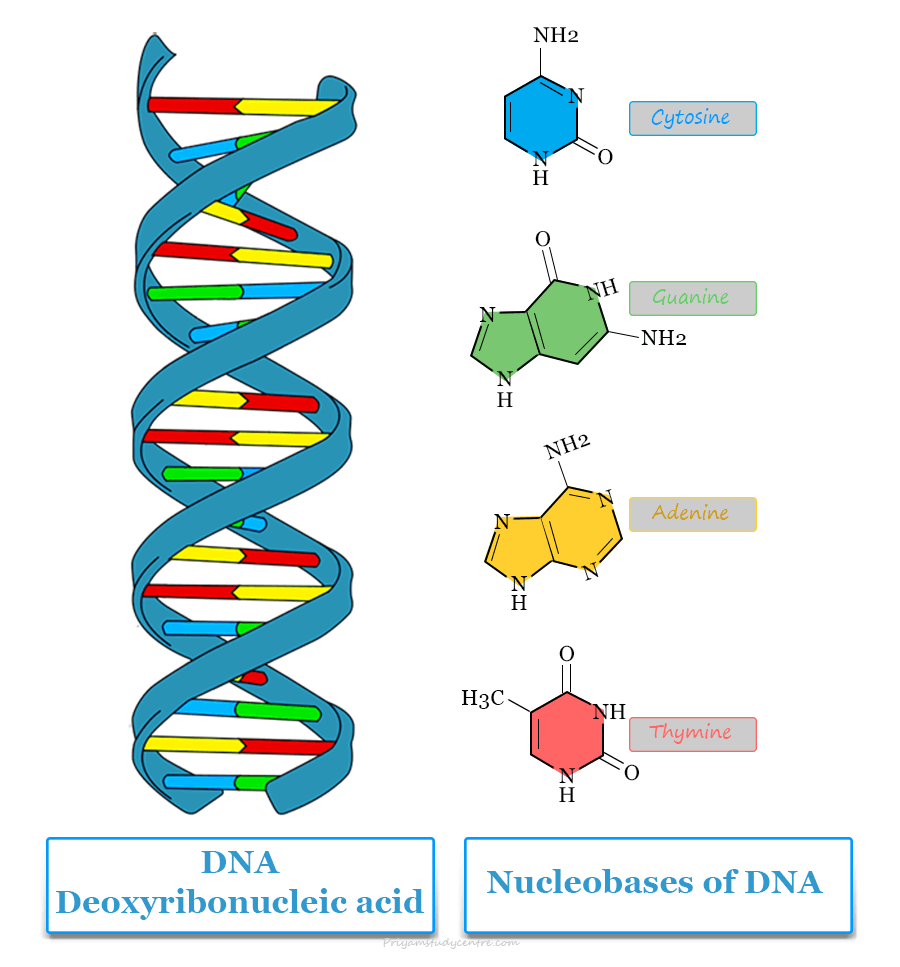
Hydrolysis of deoxyribonucleic acids by certain enzymes formed a mixture of monomers. DNA is the chemical basis of heredity or the reserve bank of genetic information. Therefore, DNA plays an important role in carrying genetic instructions for the development, growth, biological functioning, and reproduction of all known living organisms.
Discovery of Deoxyribonucleic Acid (DNA)
Many people believe that Deoxyribonucleic acid (DNA) was discovered by American biologist James Watson and English physicist Francis Crick in the 1950s but in reality, it was not the case. It was first recognized and identified in the late 1860s by Swiss chemist Friedrich Miescher during his research on white blood cells.
After Miescher’s discovery, many scientists (Phoebus Levene and Erwin Chargaff) carried out a series of research to get additional information about the deoxyribonucleic acid molecule. Hence, these various types of research provide primary chemical components and structural information about this molecule.
Without these various scientific research, Watson and Crick may never have reached their conclusion that the DNA molecule exists in the form of a three-dimensional double helix.
Deoxyribonucleic Acid (DNA) Structure
The two strands present in the DNA structure are called polynucleotides. They contain simpler monomeric units called nucleotides.
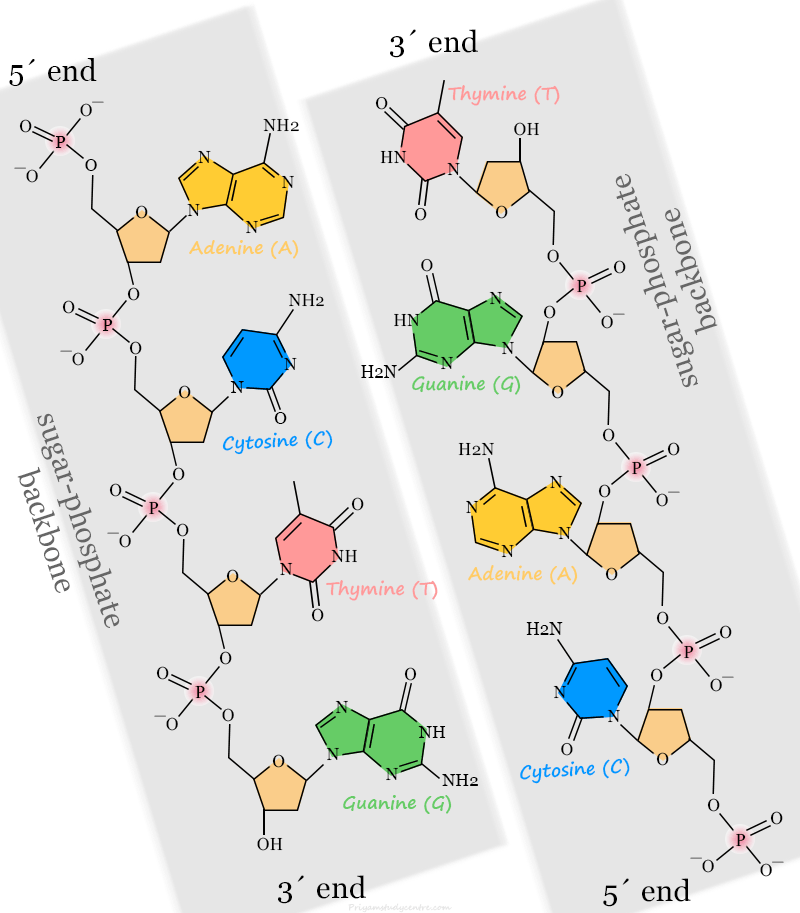
Each nucleotide consists of a nitrogenous base, a sugar called deoxyribose, and a phosphate group. Adenine (A), Thymine (T), Guanine (G), and Cytosine (C) are four nitrogen bases present in the nucleotide of a DNA molecule.
The nucleotides in deoxyribonucleic acid join to one another by covalent bonding between the sugar unit of one nucleotide and the phosphate group of the next. It results in the formation of an alternating sugar-phosphate backbone.
The nitrogenous bases of the two separate polynucleotide strands bind together by hydrogen bonding according to base pairing rules (A with T and C with G). Therefore, base pairings are essential for the formation of a double helix structure of DNA.
Nucleobase in Nucleic Acid
The nitrogenous bases found in nucleic acids contain aromatic heterocyclic organic compounds. The bases are of two types, namely purines and pyrimidines.
Nucleic acids such as deoxyribonucleic acid and ribonucleic acid contain the same purine bases namely adenine (A) and guanine (G).
However, cytosine (C) is a common pyrimidine base found in both nucleic acids. Therefore, nucleic acids differ from each other with respect to the second pyrimidine base. Deoxyribonucleic acid contains thymine (T) whereas ribonucleic acid contains uracil (U)
DNA Double Helix Structure
The double helical structure of DNA was proposed by American biologist James Watson and English physicist Francis Crick in 1953. The elucidation of DNA structure was a milestone of modern biochemistry.
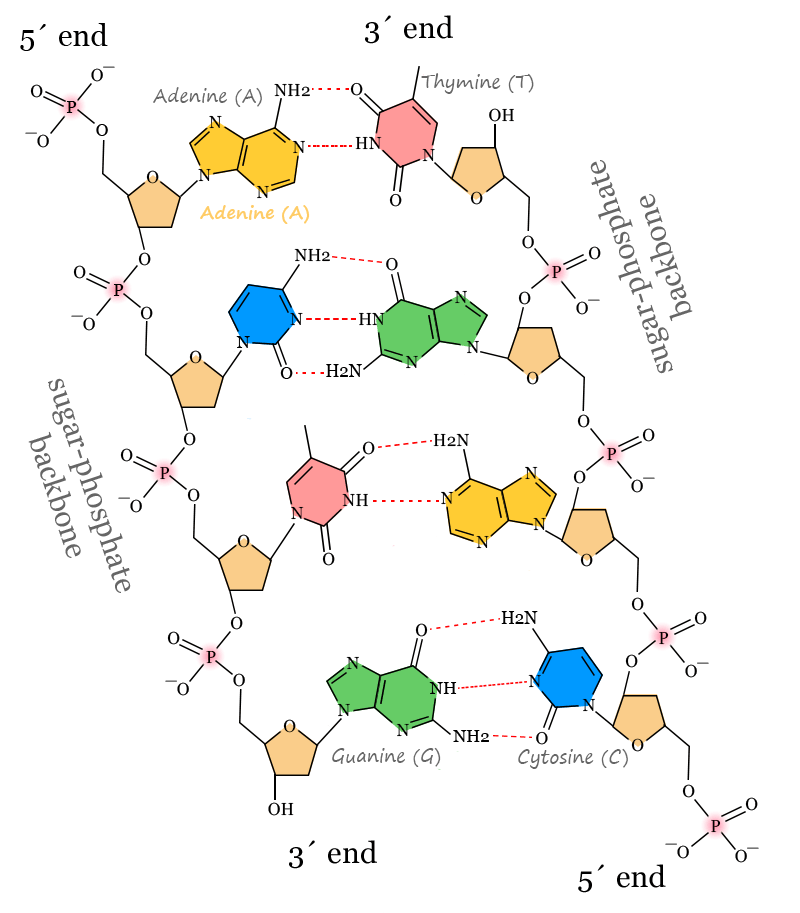
The silent features of the DNA double helical structure are
- The deoxyribonucleic acid structure contains a right-handed double helix structure where two polydeoxyribonucleotide chains twist around each other on a common axis.
- The two strands in deoxyribonucleic acid are antiparallel. Hence, one strand runs in the 5´ to 3´ direction while the other runs in the 3 to 5 direction.
- The width or diameter of a double helix is 20 Å (20 nm).
- Each turn or pitch contains 10 pairs of nucleotides.
- Each strand of this deoxyribonucleic acid contains a backbone of hydrophilic deoxyribose phosphate on the outside of the DNA molecule. However, the hydrophobic bases are stacked inside the core.
- The two polynucleotide chains in deoxyribonucleic acid are not identical but complementary to each other due to base pairing.
- The two strands in deoxyribonucleic acid hold together by hydrogen bonds formed by complementary base pairs. The A-T pair has two hydrogen bonds while the G-C pair has three hydrogen bonds.
- The complementary base pairing in DNA double helix structure is proved by Chargaff’s rule.
- The genetic information that resides on one of the two strands in the DNA helix is called the template strand or sense strand. Thus, the opposite strand is the antisense strand.
- The double helix structure of DNA contains wide major grooves and narrow minor grooves along the phosphodiester backbone. Proteins interact with deoxyribonucleic acid at these grooves without disrupting the structure of the double helix.
Chargaff’s Rule of DNA Composition
Erwin Chargaff, in the late 1940 quantitatively analyzed the DNA hydrolysates of different living species. He observed that it contains equal numbers of adenine-thymine residues and equal numbers of guanine-cytosine residues. It is called Chargaff’s rule of DNA composition.
The significance of Chargaff’s rule was not immediately realized but the strength of the double-helical DNA structure was derived later from this rule. The single-stranded DNA and RNAs generally do not obey Chargaff’s rule.
Other Types of DNA Structure
Besides the double helical structure, it may also exist in various unusual structures. Such structures are important for the molecular recognition of DNA by proteins and enzymes.
Some selected unusual structures of deoxyribonucleic acid are
- Bent deoxyribonucleic acid
- Triple-stranded deoxyribonucleic acid
- Four-stranded deoxyribonucleic acid
Types of DNA
Variation in the conformation of nucleotides, the double-helical structure of deoxyribonucleic acid exists in at least six different types such as A to E and Z. Among these, B, A, and Z are the three types of DNA that are important for us.
- B-DNA: It is a right-handed double helix described by Watson and Crick. This type of deoxyribonucleic acid is the most predominant form under physiological conditions. Each turn of the B-form contains 10 bases spinning a distance of 3.4 nm.
- A-DNA: The A-form is also a right-handed double helix that contains 11 base pairs per turn.
- Z-DNA: The Z-form or left-handed double helix contains 12 base pairs per turn. The polynucleotide strands of Z-DNA somewhat move in a zig-zag fashion.
| Types of DNA double helix | |||
| Feature | B-DNA | A-DNA | Z-DNA |
| Helix type | Right-handed | Right-handed | Left-handed |
| Number of base pairs per complete turn | 10 | 11 | 12 |
| Helical diameter (nm) | 2.37 | 2.55 | 1.84 |
| Spinning a distance (nm) | 0.34 | 0.29 | 0.37 |
Deoxyribonucleic Acid (DNA) in Cells
Most of the deoxyribonucleic acid in living organisms is located in the cell nucleus (nuclear deoxyribonucleic acid). However, a small amount of deoxyribonucleic acid also found in the mitochondria (mitochondrial deoxyribonucleic acid or mtDNA) and in the chloroplasts of plants.
The double-stranded helix in each chromosome has a definite length. Generally, it is a thousand times larger than the diameter of the nucleus.
For example, a two-meter-long human deoxyribonucleic acid packs in a nucleus of about 10 μm in diameter. Such compact packing possible due to compact and marvelous packaging and organization.
B-DNA is commonly found inside the human cell. It has a double helical structure where two strands of the duplex are antiparallel and plectonemically coiled.
Deoxyribonucleic Acid in Prokaryotic Cell
In prokaryotic cells, the deoxyribonucleic acid organizes as a single chromosome in the form of a double-stranded circle. Thus, bacterial chromosomes are packed in the form of nucleoids by the interaction of proteins and certain cations.
Deoxyribonucleic Acid in Eukaryotic Cell
In eukaryotic cells, the deoxyribonucleic acid is associated with various proteins to form chromatin which is then organized to form compact structures of chromosomes.
Deoxyribonucleic Acid (DNA) Replication
Replication is a process in which deoxyribonucleic acid copies itself to produce identical daughter molecules of deoxyribonucleic acid. Replication carries out with high fidelity and essential for the survival of the species. The replication process must occur during cell division.
Like all biological polymerization processes, replication proceeds in three enzymatically catalyzed and coordinated steps such as initiation, elongation, and termination. The enzyme, DNA polymerase involes mostly in this replication process.
The silent features of these replication steps in prokaryotes and eukaryotes are given below,
Initiation of Replication
The initiation of deoxyribonucleic acid synthesis occurs at a site called the origin of replication. In the case of prokaryotes, there is a single site whereas in eukaryotes, there are multiple sites of origin.
These sites mostly contain a short sequence of A-T base pairs. A specific protein called dna A binds with the site of origin for replication. It causes the double-standard deoxyribonucleic acid to separate.
Elongation of Replication
When the deoxyribonucleic acid strands are separated, the polymerase enzymes can start to synthesize the complementary sequence in each of the strands. The polymerase enzyme adds DNA nucleotides on the 3′ end during the elongation process.
The enzyme polymerase has a groove that binds to a single-stranded template DNA and travels one nucleotide at a time.
- For example, when the enzyme, DNA polymerase meets an adenosine base on the template strand it adds a thymidine to the 3′ end of the newly synthesized strand.
- Thereafter, it moves to the next nucleotide on the template strand.
- The process continues until this DNA polymerase molecule reaches the end of the template strand.
Termination of Replication
The duplication of genes is carried out through the pairing of replication forks which assemble at the origins of replication and move in opposite directions.
Termination of replication happens when two oppositely orientated replication forks meet and fuse. In Escherichia coli and Bacillus subtilis, termination of replication occurs in the region which situated diametrically opposite the origin. During the termination process, synthesis of deoxyribonucleic acid is completed, and new daughter molecules are resolved.
Uses of DNA Technology
DNA technology is used for the study and manipulation of genetic material. Recombinant DNA Technology (rDNA) is very useful for producing artificial DNA through the combination of different genetic materials from different sources.
DNA technology and rDNA technology play an important part in pharmacology and genetic engineering for disease prevention, increasing agricultural growth, detection of disease, and crime in forensics science.
DNA Technology in Pharmaceuticals and Medicine
In the pharmaceutical industry and medicine, this technology uses for making various types of modern drugs, hormones, and vaccines. The drugs and vaccines produced or designed by this technology help to stimulate our immune system. Therefore, they also help to prevent various health diseases.
For example, DNA technology uses for the production of various vaccines that help to eliminate some of the worst diseases on the planet such as smallpox. DNA technology is also used for the production of the COVID-19 vaccine. Therefore, it controls and reduces the number of deaths from COVID-19.
In the field of medicine, rDNA technology helps in the production of insulin, which helps to treat diabetes.
Gene cloning is also a part of this technology and plays an important role in the medicinal field. With the help of this technology, we generate various types of hormones, vitamins, and antibiotics.
It also plays an important role in gene therapy for the replacement of a faulty gene by inserting a healthy gene. Various health disorders such as leukemia and sickle cell anemia can be treated by gene therapy.
DNA Technology in Agriculture
People have been altering the genomes of plants for many years by using traditional breeding techniques. Presently, we incorporate new genes from one species into a completely unrelated species through genetic engineering. Agricultural plants are one of the most important examples of genetically modified organisms that optimize agricultural performance.
DNA technology and rDNA technology provide various common benefits in agriculture, such as increased crop yields, reduced production costs of food, reduced need for pesticides, enhanced nutrient composition and food quality, and resistance to pests and disease.
rDNA technology and biotechnology have been used for increasing the efficiency of plant growth by increasing the efficiency of the plant’s nitrogen fixation. The genes obtained from nitrogen fixation bacteria have been incorporated into plant cells by rDNA technology. Therefore, the plant cells perform a process that normally takes place in the presence of nitrogen-fixation bacteria.
DNA Technology in Forensic Science
Every people contain unique deoxyribonucleic acid sequence, and they vary from person to person. Therefore, forensic scientists scan deoxyribonucleic acid from various regions to create a DNA profile or fingerprint of a particular person.
There is a very limited possibility of a person in which they contain a similar profile or fingerprint for this DNA region. Therefore, matching DNA samples from blood, semen, skin, saliva, or hair from crime scenes and suspects provides a key source of evidence that use in our justice system.