Healthy Starch Foods
Starch is a soft, white powder and tasteless carbohydrate reserved in plants. Starches found in plants are the most important dietary source for higher animals including humans. It is a polysaccharide or biopolymer insoluble in cold water, alcohol, and other solvents. Starch is a natural polymer composed of D-glucose units held by alpha glycosidic bonds. They are a good source of nutrition because they are broken down into glucose which is the body’s main fuel or source of energy. Chemically, starch consists of two types of biomolecules: amylose (15−20%) and amylopectin (80−85%).
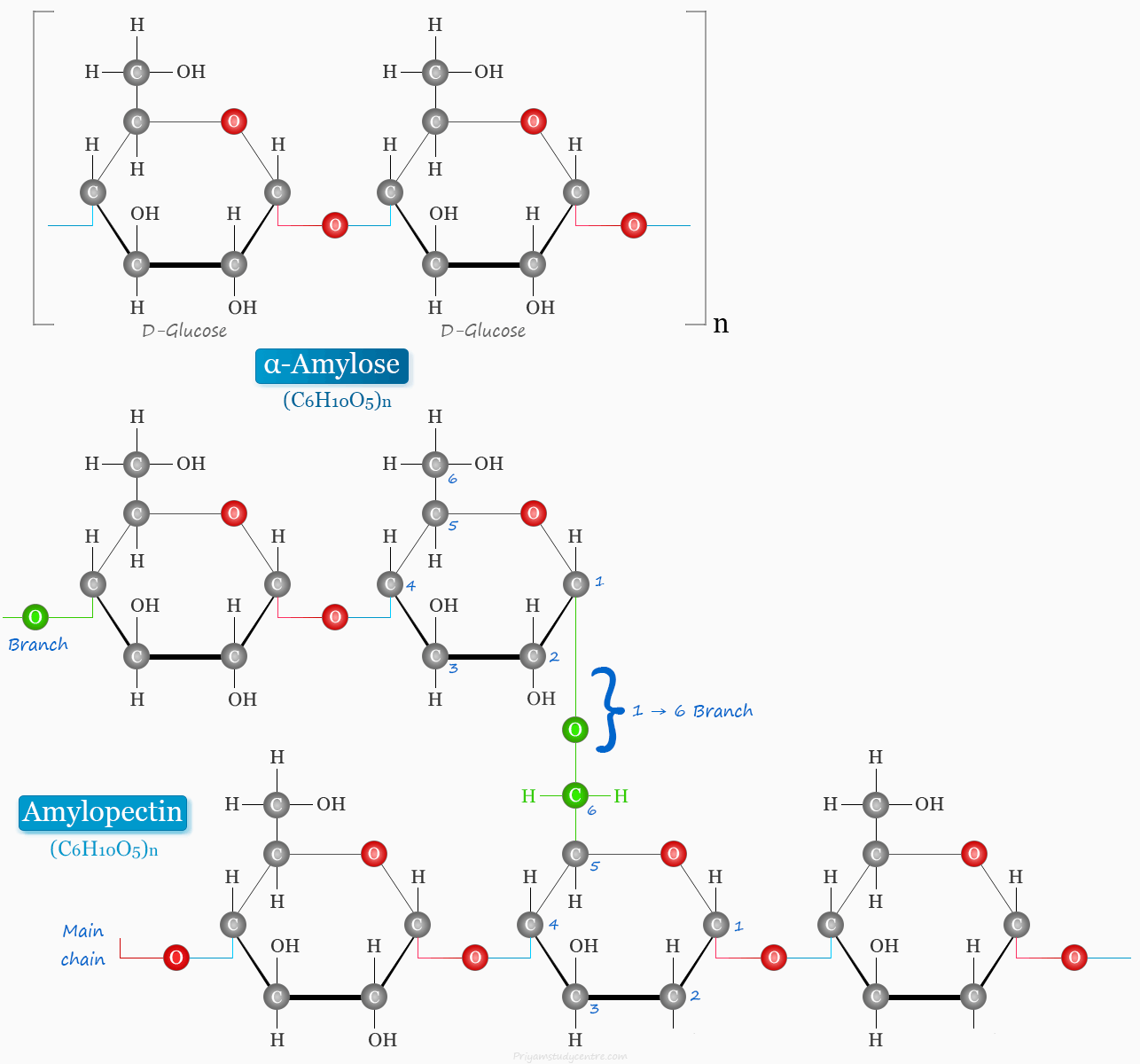
Amylose is the linear type polymer of starch while amylopectin is the branched type polymer of starch. Starch in foods is the most common sources of carbohydrate in healthy human diets. Starchy foods also contain various essential nutrients such as B vitamins, iron, calcium, and folate or folic acid.
The formation and degradation of amylopectin are important for the metabolic processes of living organisms. It is one of the two dominant components of starch that stores energy for various biological processes.
Starch in Plants
Plants can produce glucose by the process of photosynthesis and store extra glucose in the form of starch in various parts such as leaves, roots, seeds, and stems. Starches found in plants are stored in chloroplasts in the form of granules.
The main starch storage organs of plants are the roots of the cassava plant, the tuber of the potato, the stem pith of sago, and the seeds of corn, wheat, and rice.
Starch Types
Depending on the nutritional characteristics of starchy foods, starch can be divided into three groups:
- Rapidly digestible starch (RDS): It exists in cooked foods such as potatoes and bread. Our body can rapidly convert RDS to glucose.
- Slowly digestible starch (SDS): It exists in cereal grains and contains a complex structure. Our body can break down it slowly.
- Resistant starch (RS): A healthy body cannot easily digest this type of starch molecule found in foods. Similar to dietary fiber, resistant starch can pass through our digestive system untouched and support healthy intestinal microflora.
Starch is a polysaccharide made up of (1→4) and (1→6) linkages between glucose monomers with the chemical formula (C6H10O5)n. Therefore, chemically, it consists of two types of biomolecules: amylose (15−20%) and amylopectin (80−85%).
Amylose type starchy food plays an important role in storing energy in plants. Alylose type starchy constituents are less readily digested than amylopectin because their helical structure takes up less space than amylopectin. Therefore, amylose is the preferred starchy material found in plants.
Amylose
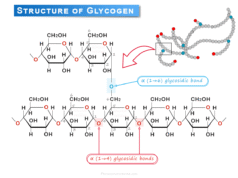
Amylose is a type of water-soluble biopolymer found in starch. It is a linear chain composed of 200−1000 D-glucose units held by α (1→4) glycosidic linkages.
The numbering of carbon atoms on glucose molecules starts from the aldehyde group. Therefore, in amylose, the 1-carbon on one glucose molecule is linked to the 4-carbon on the next glucose molecule to form an α (1→4) glycosidic bond.
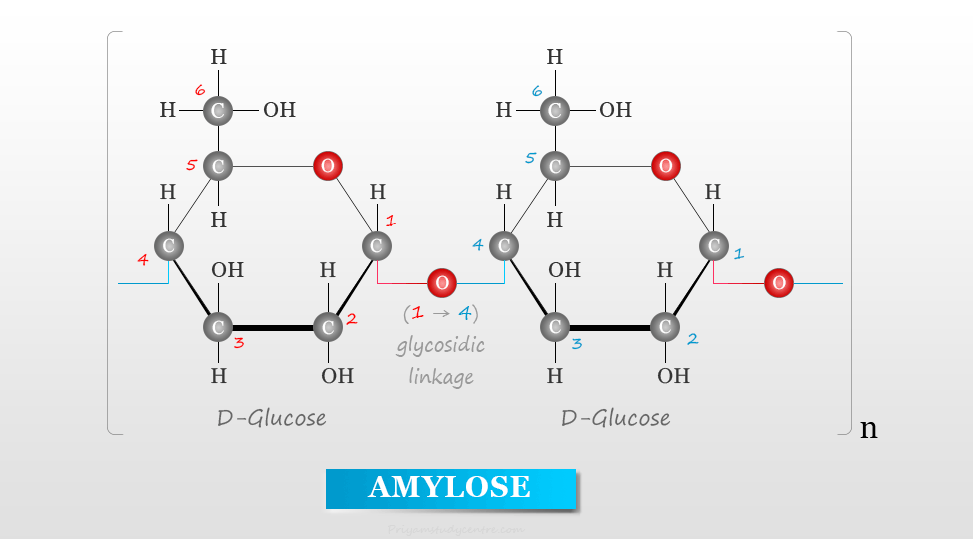
Amylose has three different forms, including one amorphous and two helical conformations. Amylose can bind with itself to form a double helix. It also binds with another hydrophobic guest molecule such as iodine, a fatty acid, or an aromatic organic molecule.
Amylose is more difficult to digest than regular starch molecules due to its dense spiral form. In the food industry, amylose is often used as a thickening, water-binding, emulsifier, stabilizing, and gelling agent.
Amylopectin
Amylopectin is a water-insoluble component of starch that is found only in plants. It is a highly branched biopolymer of D−glucose units linked together by (1→4) and (1→6) linkages.
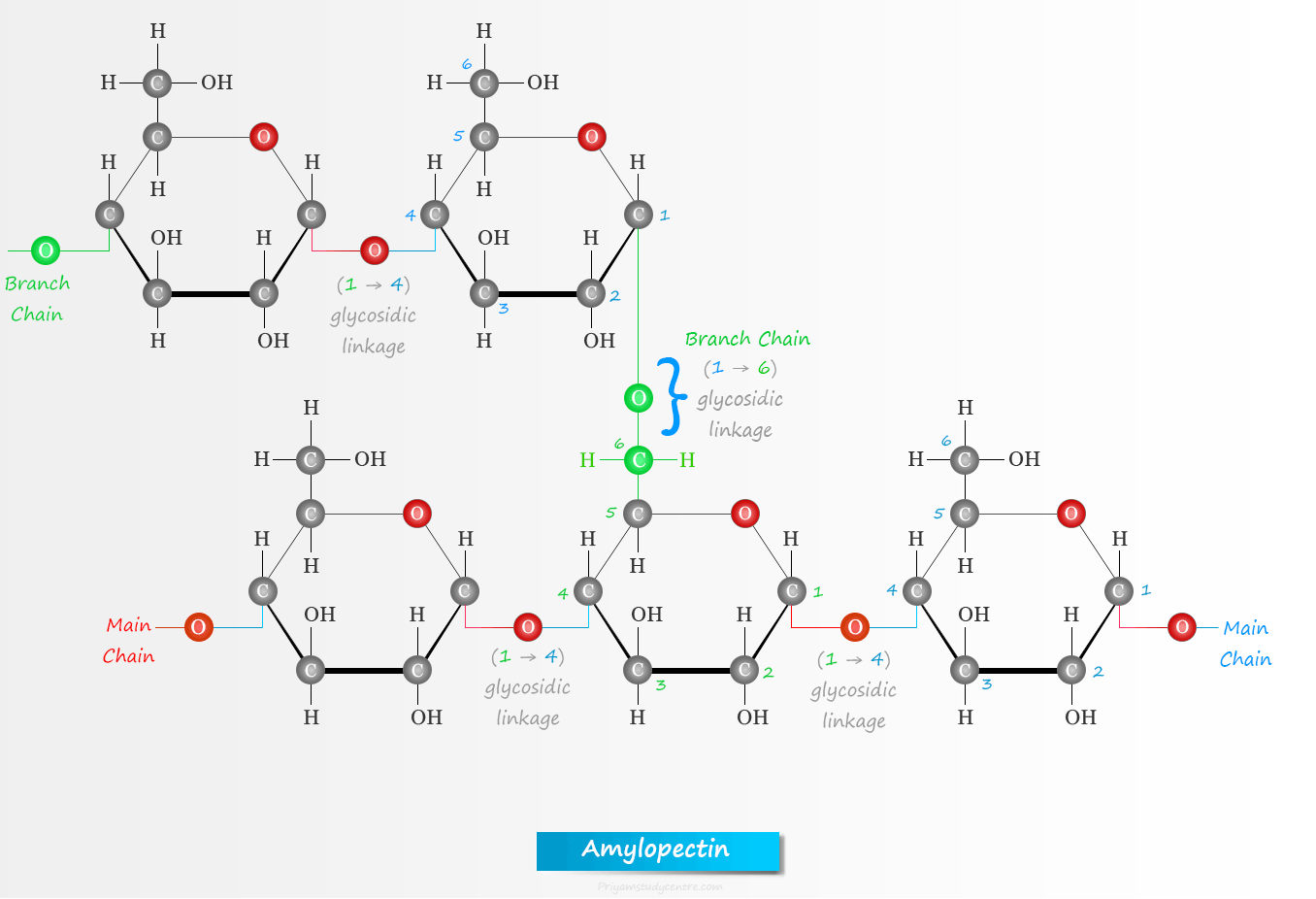
Amylopectin has a branched chain with α (1→6) glycosidic bonds at branching points and α (1→4) linkages everywhere else. It contains a few thousand glucose units and looks like a branched tree with 20−30 glucose units per branch. Therefore, amylopectin is highly branched and formed by 2,000 to 200,000 glucose units.
Amylopectin makes up to thirty percent of the storage starch found in plants but the percentage of amylopectin varies by species and variety. A high percentage of amylopectin is found in cereals such as rice, wheat, and maize, and the root vegetables potatoes and cassava.
Difference Between Amylose and Amylopectin
Amylose and amylopectin are the two polysaccharide components of starch but they differ from each other in many respects. The most common differences between amylose and amylopectin are:
| Amylose | Amylopectin |
| Amylose is a biopolymer that contains a long unbranched chain with 200−1000 D−glucose units. | Amylopectin is a biopolymer that contains a long branched chain with a few thousand D−glucose units. |
| It is soluble in water solution. | It is insoluble in water solution. |
| Straight long chain structure. | Branched-chain structure. |
| Amylose contains α (1→4) glycosidic bonds between two glucose units. | Amylopectin contains α (1→4) glycosidic bonds between two glucose units in the straight chain and α (1→6) glycosidic bonds at the branching. |
| When iodine is added, amylose becomes blue. | When iodine is added, amylopectin becomes red. |
| Amylose makes up roughly 10 to 20 percent of total starch. | Amylopectin makes up roughly 80 to 90 percent of total starch. |
| Amylose may be hydrolyzed by the enzyme amylase. | Amylopectin can’t be entirely digested by the enzyme amylase. |
Resistant Starch
Resistant starch is a type of carbohydrate molecule that is not digested in the small intestine but ferments in the large intestine and helps to feed good gut bacteria. It occurs naturally in various food items and it can also be added to various dried raw foods.
RS is also used as an additive in the manufacturing of various food items. Resistant starches (RS) found in various food items are divided into four main categories, including:
- RS1: Undigestible resistant starch found in seeds or legumes and unprocessed whole grains.
- RS2: Starch, which is inaccessible to enzymes due to its conformation. It is found mostly in green bananas, raw potatoes, etc.
- RS3: Such types of starches are found in foods that undergo cooking and then cooling such as rice, cornflakes, and pasta.
- RS4: Starches found in bread and chemically modified to resist digestion.
Properties of Starch
Starch is a natural biopolymer, or polysaccharide, formed by straight-chain amylose and branched-chain amylopectin. Amylose is a linear or straight-chain amorphous solid but amylopectin is a branched-chain crystalline form. Pure forms of starches are white, tasteless, and odorless powder.
Pure starch is insoluble in cold water but when it is heated with water, a colloidal suspension forms due to the swelling of granules. However, it readily dissove in hot water but after cooling, it forms a paste or gel of starch.
| Properties of Starch | |
| Chemical formula | (C6H10O5)n +(H2O) |
| CAS Number | 9005-25-8 |
| Appearance | White powder |
| Density | Variable density found for various forms. |
| Solubility in water | Insoluble in cold water but soluble in hot water. |
Starches are hydrolyzed by the enzyme amylase (pancreatic or salivary) to liberate dextrins and finally form maltose and glucose. Therefore, dextrins are breakdown products of starch by the enzyme amylase or dilute acids.
Gelatinization of Starch
Insolubility of this biomolecule in cold water at room temperature due to its semi-crystalline structure. When heated in abundant water, the semi-crystalline structure is lost.
The smaller amylose component starts leaching out of the granule and forming a network that holds water. Therefore, it increases the mixture’s viscosity. It is called starch gelatinization.
Starch Iodine Test
The foods that we eat daily contain different types of carbohydrates. Along with other carbohydrates, starch and sugars are the main components found in our healthy food items.
The iodine starch test is a chemical reaction used to detect healthy starchy foods that contain various types of carbohydrates.
To perform this test, we make a light orange-brown solution of iodine (I2) and potassium iodide (KI) in water because molecular iodine is not easily soluble in water solution. Therefore, we used it together with potassium iodide. These two substances formed polyiodide ions in their solution.
Starch is a carbohydrate that contains two different forms of polysaccharides connected in two different ways. One form is the linear amylose and the other form is the branched amylopectin.
Amylose is the component that is responsible for the blue colour. When we added it to a sample that contained amylose, it changed to a deep blue colour.
Once amylose is added, it forms a charge transfer complex where amylose is a charge donor and the polyiodide is a charge acceptor. Such a charge transfer complex absorbs light of a different wavelength than polyiodide, and the colour turns dark blue.
Such a test was first described by J. J. Colin and H. F. Gaultier de Claubry, and independently by F. Stromeyer in 1814. The test cannot be performed at very low pH because starch may be hydrolyzed under such conditions.
Starch Indicator
Starch is used in chemistry as an indicator for the detection of the endpoint of titrations involving iodine solutions. It reacts with iodine in the presence of triiodide ion to form a deep blue colored complex and it is visible at very low concentrations of iodine. Therefore, it is a very good indicator in indirect iodometric titrations.
During iodometric titration, concentrated iodine solutions must be reacted with some titrant. Therefore, we use thiosulfate to remove most of the iodine before the titration is performed. The insolubility of the starch–triiodide complex prevents some of the iodine from reacting with the titrant.
Benefits of Starch
Starchy foods are the most common sources of carbohydrate in human diets. They are a good source of nutrition because they are broken down into glucose which is the body’s common source of energy.
Starch is a carbohydrate and a natural biopolymer of most plants, including fruits, vegetables, and grains. Starchy foods are a beneficial and essential part of our balanced diet because they provide energy, fiber, and a sense of fullness. Such types of foods also contain various essential nutrients such as B vitamins, iron, calcium, folate (folic acid), etc.
A healthy body breaks down starch molecules present in foods into glucose, which is the main source of energy to control various biological processes. Our brain requires a considerable amount of glucose each day.
Corn, wheat, and synthetic starches are the main types of starch that are good for clothes in a commercial laundry. Among these, cornstarch is widely available and relatively inexpensive. It provides a smooth and crisp finish to the fabrics of your clothes.
Healthiest Starchy Foods
The major sources of starch for people include cereals (rice, wheat, and maize) and root vegetables (potatoes and cassava). Starchy foods are safe and beneficial for most individuals because they do not cause any side effects.
Starchy foods such as potatoes, bread, rice, pasta, and cereals are the main sources of starch and play an important role in a healthy diet.
Among these, potatoes are the healthiest choice of starchy foods and a good source of energy, fiber, B vitamins, and potassium. Rice and grains are an excellent choice of the healthiest starchy foods that give us the energy to maintain our good health.
Starch Foods Disadvantages
Diets with highly refined starches are bad for you because they increses higher risk of diabetes, heart disease, and weight gain. In addition, starch may also be bad for you because it spikes blood sugar levels rapidly and falls sharply.
Therefore, it is important for people with diabetes and prediabetes to avoid highly refined starches in their daily diets because their bodies can’t efficiently remove sugar from the blood. On the other hand, starchy foods should not be avoided because they are a great source of fiber and contain a variety of vitamins and minerals.
Uses of Starch
Starch is an important nutrient that is stored widely in plants and is taken widely by higher animals. Starchy foods are the primary source of carbohydrates for higher animals including humans.
- Foods that contain a high level of starch are good for human nutrition. Starchy foods are broken down into glucose which is the main source of energy for the brain and muscles. The essential nutrients (B vitamins, iron, calcium, and folate) are also found in starchy food items.
- In industry, starch is converted into sugars which are fermented to produce ethanol in the manufacture of beer, whisky, and biofuel.
- Papermaking is the largest non-food industrial application of starches globally. In the paper industry, it is used for making corrugated paperboard, paper bags, and boxes, and gummed paper and tape.
- Starch is an important natural component for making bioplastics.